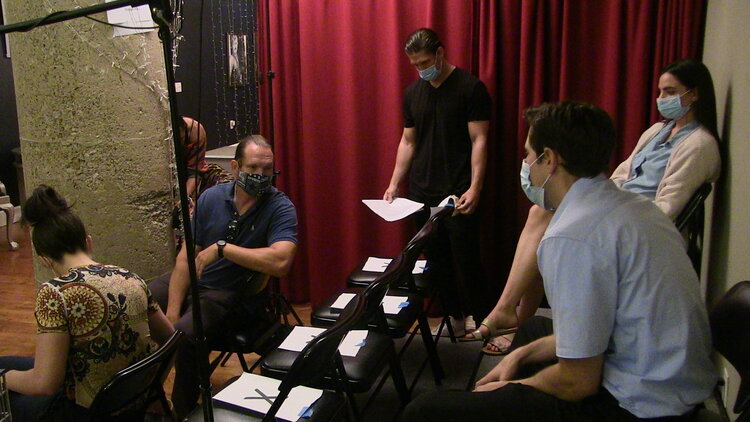
Auditions and acting business knowledge are the two pillars every working actor in Dallas must master. However, most actors are only trained in one. Consequently, they walk out of auditions feeling lost, or they build talent without ever building a career.
If you've ever left an audition thinking, "I have no idea what just happened," you are in very good company.
Auditioning Is Not Acting
Auditioning, acting in class, and performing on set are three completely different skills. Therefore, if you treat them the same way, you will feel like you're failing at all of them.
In class, you have time. You have rehearsal. You have relationships with scene partners. However, in an audition, you are asked to create a full human life, with backstory, values, quirks, and behavior, in minutes, under pressure, with limited information.
Additionally, just when you think you understand the process, someone says, "Great. Now do it a completely different way," with zero direction. In the acting world, that is completely normal.
In-Person Auditions and Self-Tapes
In-person auditions are a performance under pressure. You walk into the room, find your mark, and begin. Meanwhile, your body is hyper-aware, a million thoughts compete for space, and your reader often sounds like they have given up on life entirely.
You are being evaluated on your presence, your talent, how you handle pressure, and whether you are someone people will want to work with. Consequently, half of your audition happens before you ever speak.
Self-tapes, on the other hand, are where actors quietly unravel. You are simultaneously the actor, the director, the camera operator, the lighting department, the sound engineer, and often your own worst enemy. You can do 17 takes. You can chase perfection. You can slowly drain every drop of life out of your work.
Therefore, self-tapes require fast and clear choices, technical skill in framing and sound, restraint, and the ability to stay alive and spontaneous while working completely alone. Without discipline, it becomes chaos.
Being on Set and Where Actors Get Stuck
On set, you have direction, relationships, support, and multiple takes. Your job is simply to be truthful to the writer's intention, be interesting, and not be difficult to work with.
However, most actors are trained only in scene work. Consequently, they audition like they are doing a full scene, and it collapses. Auditioning requires speed, precision, immediate connection, and the ability to drop in instantly. It is not less than acting. It is simply different.
Casting is not looking for perfection. They are looking for confidence, clarity, presence, and someone who feels like they already belong in the role. You do not book because you "acted well." You book because they can see you doing the job.
The Business of Acting
Talent gets you in the room. However, the business gets you the room in the first place. Additionally, without the right infrastructure, your talent remains invisible.
Agents and Representation
A talent agent opens doors to auditions you cannot access on your own. Legitimate agents work on commission of 10 to 15 percent and never charge upfront fees. Additionally, regional representation is a smart first step. Build your credits first, then approach agents with a strong reel and a clear sense of the roles you are right for.
Headshots
Before casting hears your voice or watches your reel, they see your face. Therefore, a great headshot is not a glamour shot. It is an authentic, specific image of the person who will walk into that audition. Hire a photographer who specializes in actors, maintain multiple shots across dramatic, comedic, and commercial ranges, and update your headshots whenever your look changes significantly.
IMDb and Casting Platforms
IMDb is the first place industry professionals go to verify your credits. Consequently, if you have film or television work, you need a complete and accurate IMDb page. IMDbPro goes further, allowing you to list your representation and track who is searching for you.
Additionally, professional casting has moved online. The major platforms every actor must maintain are Actors Access for film and TV submissions, Casting Networks for TV and commercial work, and Backstage for independent film and theatre.
Social Media and Your Digital Footprint
Casting directors, producers, and agents will look you up. Therefore, what they find shapes their impression before you have said a word. Pick one or two platforms such as Instagram or YouTube and do them well. Share your work, your process, and behind-the-scenes content. Additionally, a clean personal website linking your reel, headshots, and contact information is still worth having.
The actors who build lasting careers train relentlessly and market themselves strategically. Similarly, your IMDb page, casting profiles, and social presence are not afterthoughts. They are the infrastructure that makes your talent findable.
Frequently Asked Questions
What is the difference between auditioning and acting? Auditioning requires speed, precision, and immediate character connection under pressure. Acting in class or on set allows for more time, rehearsal, and relationship. They require different skills entirely.
What do casting directors look for in an audition? They look for confidence, clarity, presence, and someone who feels like they already belong in the role. They want to see that you can do the job, not just that you can act.
What platforms do actors need to be on? Actors should maintain profiles on Actors Access, Casting Networks, and Backstage, as well as a complete IMDb page once they have professional credits.
How important are headshots for actors? Headshots are your most important marketing tool. Casting sees your face before anything else, so your headshots must be current, authentic, and specific to the roles you are right for.
Ready to take your career to the next level? Visit TBell Actors Studio to learn more about training, courses, and everything you need to become a working actor.
TBell Actors Studio is now offering The Working Actor Course. This is a six-week course taught by Master Class Actor Mary Blackburn, running Saturdays from May 16 through June 20, from 1:30 to 4:30 p.m. at the studio. We cover everything you need to know about in-person auditions, self-tapes, and the business of acting. All information is on the attached flyer. We hope you can join us!